
Short overview of the Gracie BJJ history
The Gracies are a Brazilian family with a long history in martial arts. The patriarch, Helio Gracie, was born in Belem do Para, Brazil, in 1913. He was a sickly child who couldn't join in many physical activities, so he started studying jiu-jitsu young. He fell for it quickly and dedicated his life to mastering it.
Helio's nephew Carlson Gracie Sr. also helped shape BJJ and became one of the most successful competitors in jiu-jitsu history. Other famous Gracies in the sport include Rickson Gracie and Royce Gracie.
The early history of Brazilian jiu jitsu
The history of Brazilian Jiu-Jitsu goes back to the early 20th century, when Japanese judo master Mitsuyo Maeda migrated to Brazil.
The jiu-jitsu it grew from is much older. Some trace it to around 300 BC, when Buddhist monks practiced an early form. Their philosophy valued all life and rejected harming any living thing, so they chose a self-defense form that let them defend themselves without harming their attacker.
Jiu-jitsu got a solid foothold in 17th century Japan, when samurai learned grappling to defeat armored opponents without a weapon, using joint locks, pins, and throws.
Jigoro Kano (嘉納 治五郎, Kanō Jigorō) was a Japanese educator and the founder of judo. Born in Kōbe, Japan, in 1860, he grew up in a wealthy merchant family. At eighteen he began studying jujutsu under Master Tsunetoshi Iikubo.
That study shaped judo in two ways. Kano learned to use leverage and timing to beat an opponent instead of brute force. He also picked up the principles of "maximum efficiency" and "minimum effort," which he built into his judo teaching and which strongly influenced one of his students, Mitsuyo Maeda.
Mitsuyo Maeda
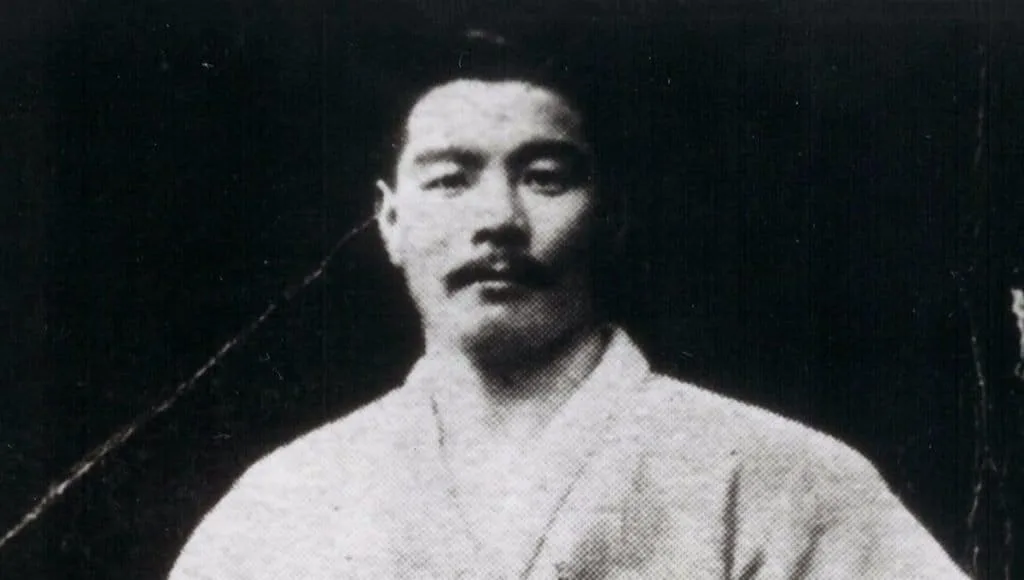
Mitsuyo Maeda was a Japanese judo and Brazilian jiu-jitsu master credited as a co-founder of Brazilian jiu-jitsu. Born in Hyōgo Prefecture, Japan, he began training in Kodokan judo as a child under its founder, Jigoro Kano. He earned his black belt and competed in numerous judo tournaments. In 1904 he traveled to the United States with a group of judoka to demonstrate Kodokan judo.
In 1914, Maeda moved to Brazil at the invitation of Brazilian businessman Gastão Gracie. He taught judo to Gastão's son Carlos Gracie and helped him open the first Gracie Academy. He also taught Carlos' brothers Oswaldo, George, and Helio. In 1925, Maeda retired from active competition and opened his own judo school in Belem. He taught judo until his death in 1941.
Hélio Gracie: the father of BJJ
Hélio Gracie was born in Belém do Pará, Brazil, on October 1, 1913, the youngest of five children of Gastão and Cesária Gracie. His father was a successful businessman. Hélio's older brothers Carlos, Oswaldo, and George learned jiu-jitsu from Carlos at a young age. Hélio showed little interest at first and preferred football (soccer). After his brothers constantly teased him about his lack of physical prowess, he gave in and began training under Carlos.
Carlos was one of the first Brazilian jiu-jitsu masters, and Hélio learned the basic techniques from him. He went on to develop his own system, which became known as Gracie Jiu-Jitsu. In the early 1950s he opened the first Gracie Jiu-Jitsu Academy in Brazil. He died in 2009 at the age of 95.
His system rested on the principle that a smaller person could defend against a larger, stronger opponent using leverage and proper technique. He believed jiu-jitsu was the ultimate form of self-defense because it relied on technique and skill, not size or strength. It gained popularity in Brazil and eventually spread to the United States and other countries.
Rorion Gracie and the UFC
One of Helio's sons, Rorion Gracie, moved to the United States in 1978 and later opened the first Gracie Jiu-Jitsu Academy in Beverly Hills, California. He teamed up with a promoter named Art Davie to create the Ultimate Fighting Championship (UFC), a way to show off his family's style and match it against other martial arts.
The UFC held its first event in 1993, a tournament designed to find out which style was most effective. In the early years Gracie Jiu Jitsu was one of the most successful styles, with Royce Gracie winning 3 of the first 4 UFC tournaments.
The UFC has since grown into a multi-billion dollar organization and the largest MMA promotion in the world. BJJ is no longer as dominant there as it once was, but many current and former UFC champions have some background in it.
Royce Gracie and UFC 1
Royce Gracie fought at the first-ever UFC event, held on November 12th, 1993. It was his MMA debut. He was pitted against Art Jimmerson, a boxer, and beat him by submission with a gi choke only 2 minutes in.
He went on to win his next two matches in the tournament, against Ken Shamrock and Gerard Gordeau. He won the tournament by submitting Gordeau with a gi choke.
The win earned him widespread respect. He's considered one of the pioneers of MMA and helped popularize Gracie Jiu Jitsu around the world.
Gracie Barra and Carlos Gracie
Gracie Barra is an association founded by Carlos Gracie Jr. in 1986. It's one of the largest and most traditional Brazilian jiu-jitsu associations in the world.
Gracie Barra had its headquarters in Rio de Janeiro, Brazil, and also has regional headquarters in the United States, Europe, Asia, and Australia. It teaches Brazilian jiu-jitsu to people of all ages and levels, from beginners to black belts.
The 2000s
In the early 2000s a new generation of fighters, such as Roger Gracie and Marcelo Garcia, emerged and quickly became some of the most dominant names in the sport. BJJ has since become one of the most popular martial arts in the world, with thousands of schools teaching people of all ages and backgrounds.
In 2005, Master Carlos Gracie Jr. relocated the HQ from Rio de Janeiro to Lake Forest in California. Starting almost over, he and many of his black belt students began growing the BJJ scene in California and later the US. The HQ has grown from a small warehouse gym to a 7,000 square feet facility with dozens if not hundreds of elite-level students who will continue spreading the Gracie Jiu-Jitsu principles all over the world.